DreaMS embeddings
DreaMS (Deep Representations Empowering the Annotation of Mass Spectra) embeddings are high-dimensional vector representations of MS/MS spectra, derived from our transformer neural network trained on millions of mass spectra from the MassIVE GNPS repository. For details, please refer to our paper. The paper demonstrates that DreaMS representations of spectra encode the molecular structures corresponding to those spectra. As a result, DreaMS can serve as a core for various mass spectrum annotation tasks, such as library matching, molecular networking, or molecular property prediction.
Computing embeddings
Let’s see how to generate DreaMS embeddings for a given .mzML file in a single line of code.
[2]:
from dreams.api import dreams_embeddings
dreams_embs = dreams_embeddings('../data/MSV00008490/G72676_BB5_01_18927.mzML')
dreams_embs.shape
Computing DreaMS embedding: 100%|██████████| 2308/2308 [00:56<00:00, 40.80it/s]
[2]:
(2308, 1024)
The resulting dreams_embs object is a NumPy matrix with 2308 rows and 1024 columns. Each row represents a 1024-dimensional DreaMS embedding for one of the 2308 MS/MS spectra present in the input .mzML file.
Note that computing 2308 embeddings took less than a minute on a laptop (MacBook M1). However, the computation is orders of magnitude faster on a GPU machine.
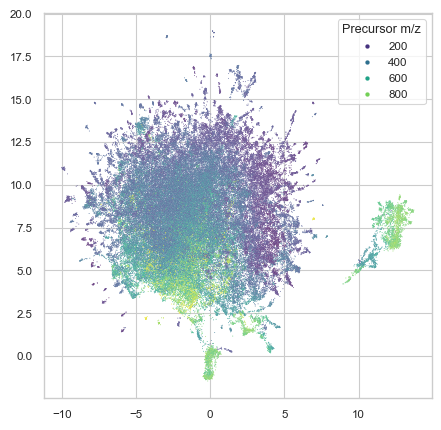
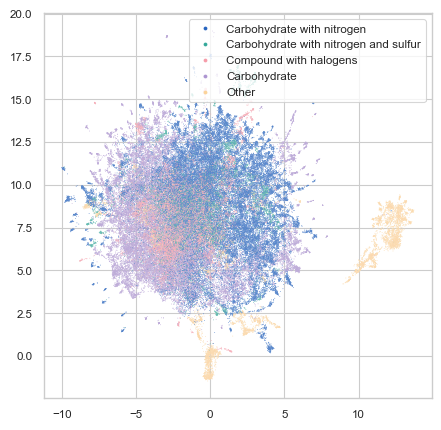
Visualizing embeddings with UMAP
The DreaMS embeddings can be visualized using UMAP, a dimensionality reduction technique that is well-suited for visualizing high-dimensional data. We will use it to map 1024-dimensional DreaMS embeddings into 2D space and then color each embedding (i.e., point) based on different properties (formula type and precursor m/z). For this purpose, we will use a large sample of 100,000 pre-computed embeddings from the MassSpecGym dataset. The file with the pre-computed embeddings is available here.
Import all necessary packages.
[3]:
import random
import umap
import numpy as np
import seaborn as sns
import matplotlib.pyplot as plt
from dreams.utils.data import MSData
from dreams.utils.plots import init_plotting
from dreams.utils.mols import formula_type
from dreams.definitions import DREAMS_EMBEDDING
[4]:
msdata = MSData.load('../data/MassSpecGym_DreaMS.hdf5', in_mem=True)
embs = msdata[DREAMS_EMBEDDING]
embs.shape
Loading dataset MassSpecGym_DreaMS into memory (213548 spectra)...
[4]:
(213548, 1024)
[10]:
random.seed(777)
idx = random.sample(list(range(embs.shape[0])), 100_000)
embs_sample = embs[idx]

reducer = umap.UMAP(metric='cosine', min_dist=0.4, n_neighbors=50)
embs_umap = reducer.fit_transform(embs_sample)
init_plotting(figsize=(5, 5))
formulas = np.array(msdata['FORMULA'])[idx]
sns.scatterplot(
    x=embs_umap[:, 0],
    y=embs_umap[:, 1],
    hue=[formula_type(f) for f in formulas],
    alpha=1,
    s=0.3,
    palette=['#2664BF', '#34A89A', '#F69CA9', '#AD95D1', '#FBD399']
)
plt.legend(markerscale=5)
plt.show()
[11]:
init_plotting(figsize=(5, 5))
sns.scatterplot(
    x=embs_umap[:, 0],
    y=embs_umap[:, 1],
    hue=msdata.get_prec_mzs()[idx],
    alpha=1,
    s=0.4,
    palette='viridis'
)
plt.legend(title='Precursor m/z', markerscale=5)
plt.show()